Case File · PURSUE coverage
The Sandia File: 116 Pages From the Dawn of the Nuclear UFO Era
Updated July 7, 2026 · Alan E. Keene
The record
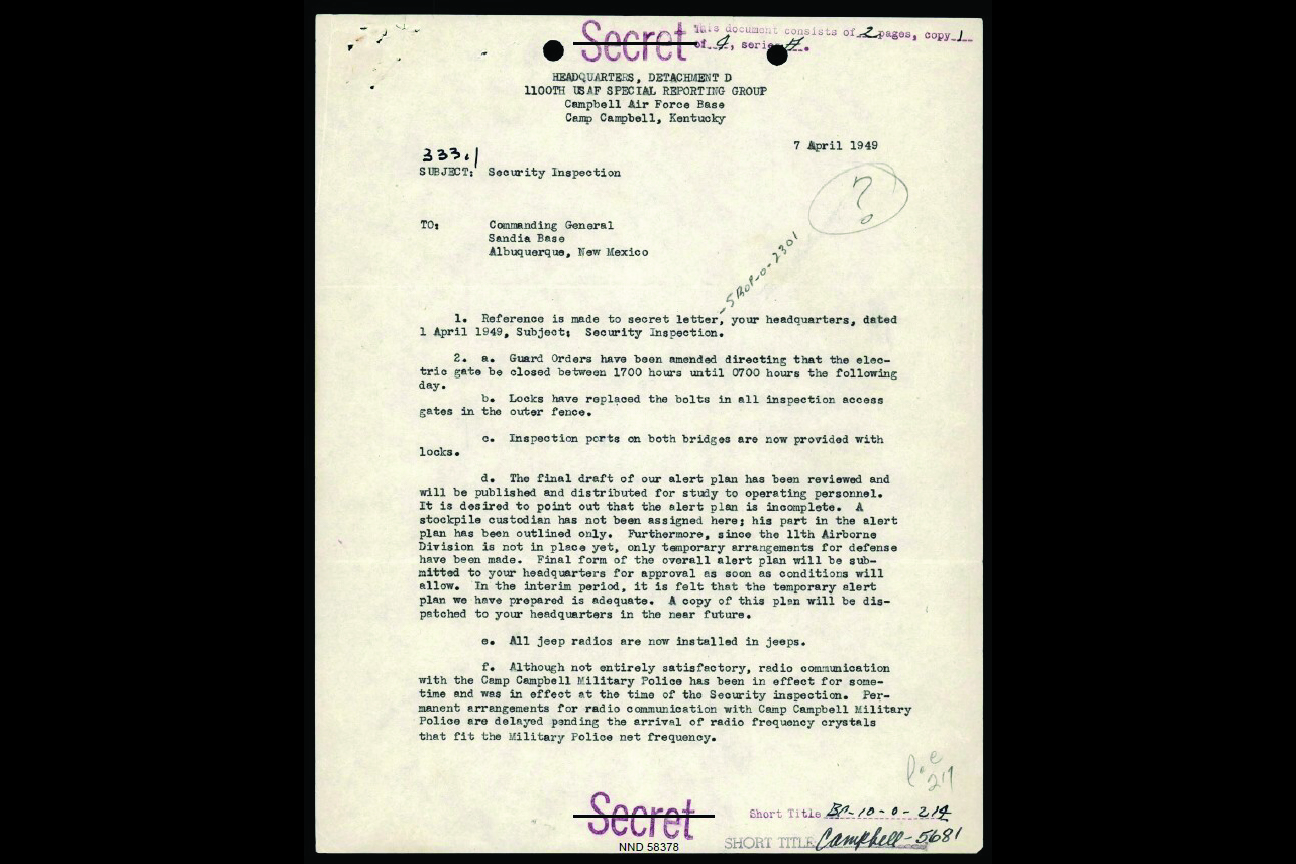
DOW-UAP-D017, published in PURSUE Release 02 on May 22, 2026, is the largest historical document set in the archive: 116 pages of security correspondence from Sandia Base, New Mexico, covering 1948 to 1950 and documenting, by the file's own accounting, 209 individual sightings near what was then the United States' primary nuclear weapons assembly site.
The scanned correspondence is served from war.gov/UFO and indexed in our file archive.
What the pages contain
Three categories of report recur through the file. The most numerous are the green fireballs: luminous green objects at high velocity, repeatedly noted for producing no sound. Second, luminous discs — the classic saucer reports of the era — described hovering near the weapons facilities. Third, low-altitude fireballs whose paths appeared to follow terrain, which the correspondence's authors read as suggesting controlled flight rather than ballistic fall.
What makes the file historically valuable is less any single sighting than its texture: this is internal security paperwork, written by base security officers for their chain of command, with no public audience in mind. The authors are not promoting a mystery; they are complaining about one. Reports of interceptors failing to catch the objects, and of sightings clustering directly over weapon storage areas across a single 72-hour period in 1948, read as operational irritants documented by people whose job was to worry about the perimeter.
Context: the green fireballs were a real government headache
The Sandia file does not arrive in a vacuum. The late-1940s green fireball wave over New Mexico is one of the best-documented episodes in UFO history — it triggered a real Air Force inquiry (Project Twinkle, stood up in 1949) and drew in Lincoln LaPaz, the era's leading meteor scientist, who argued publicly that the fireballs' flat trajectories and repeat appearances did not behave like meteors. That investigation ended inconclusively and its records scattered. D017 adds the security-office view of the same period: the same sky, seen not by scientists but by the people guarding the bombs.
The location matters as much as the lights. In 1948, Sandia and nearby Los Alamos and Kirtland constituted the most sensitive square mileage in the Western world. Anything unexplained overhead was, by definition, a national security problem — which is why the paper trail exists at all.
Open questions
What the release does not answer: whether the 209 sightings were ever cross-referenced against Project Twinkle's instrumented observations; how many reports describe independent events versus multiple witnesses of single events; whether the file's interceptor-evasion accounts reflect measured tracks or visual impressions; and where the follow-up correspondence went — 116 pages of complaints usually generate replies, and the replies are not in the file.
Our read
Our read: D017 is the strongest historical file in the archive because its provenance is boring — internal security mail, written contemporaneously, released by the government that wrote it. (Confirmed by document.) The green fireballs may yet have a natural explanation; LaPaz never proved his case, and seventy-five years of atmospheric science have added candidates. But the file establishes beyond argument that the nuclear-site correlation was noticed, documented, and left unresolved from the very first years of the atomic age — which makes it the founding entry in the pattern our nuclear-sites analysis traces to the present. (Assessment.)
Related records & reading
The nuclear-site pattern, 1948–2026 · AARO's Blue Book audit · The 1973 CIA report · What "unresolved" means · The full record in the archive ↗